
The Supreme Court has directed the Delhi High Court to reconsider a plea by 11 members of the Delhi Gymkhana Club challenging the Centre's decision to take over 27.3 acres of land leased to the club and subsequent eviction proceedings. The members argue that the government-nominated management cannot effectively challenge the Centre's actions, which they deem a "colourable exercise" of power and a violation of fundamental rights.

Supreme Court Justice Vikram Nath stated that eligibility and merit, not personal identity, should be the sole criteria for selection in public service. Speaking at the UPPSC premises, he highlighted the constitutional safeguards for impartiality in public service commissions and the far-reaching impact of their selections. His visit marked a historic first for the commission.

Shiv Sena (UBT) leader Sanjay Raut stated on Friday that he is prepared to apologise to the Supreme Court if his remarks were deemed inappropriate, emphasising his party's respect for the judiciary. His comments followed observations by Chief Justice of India Surya Kant regarding attempts to browbeat the judiciary. Raut also linked his apology to demands for justice concerning alleged electoral roll irregularities and the delayed hearing on the Shiv Sena name and symbol dispute.

The Supreme Court-appointed High Powered Enquiry Committee (HPEC) will hold a sitting on October 29 to hear affected persons and record evidence regarding alleged violence, including pellet gun use and harassment of female protesters, during the July Jantar Mantar protests. The five-member panel, chaired by Justice R Subhash Reddy, was formed after petitions alleged police excesses and counter-allegations of violence against police. An online portal is also available for submissions.
The Supreme Court has refused to stay contempt proceedings initiated by the Bombay High Court against a judicial officer for an "unwarranted outburst" in court. The apex court observed that a judicial officer cannot shout at judges and deemed the officer's conduct as "gross indiscipline," advising him to tender an unconditional apology to the High Court. The High Court had initiated proceedings after the officer allegedly blamed the court administration in a high-pitched tone during a hearing on fast-track court posts.

Major opposition leaders, including Rahul Gandhi and Mallikarjun Kharge, have filed a petition in the Supreme Court challenging alleged large-scale voter deletions and irregularities in the Special Intensive Revision (SIR) of electoral rolls. This action follows a "March for Democracy" and a declined request to meet the Chief Justice of India regarding "vote chori" allegations.

The Supreme Court has permitted the Unnao rape survivor to become a party in the CBI's petition challenging the suspension of Kuldeep Singh Sengar's life imprisonment, affirming the victim's right to be heard in the proceedings.
The Joint Parliamentary Committee (JPC) on simultaneous elections had scheduled an "informal interaction" with Supreme Court judges, which was later cancelled by the apex court. The Supreme Court deemed the meeting inappropriate as the proposed constitutional amendment could become subject to judicial review. JPC Chairman PP Chaudhary defended the panel's initial decision, citing precedents, while DMK MP P Wilson, who mooted the idea, expressed disappointment and argued against the notion that such interactions violate separation of powers.

'My argument was straightforward: If the Constitution allows this reservation and SC/ST and OBC candidates are already getting reservation in private institutions -- backed by Constitution Bench orders -- then not extending the same to EWS candidates directly violates the 103rd Amendment and Article 14, which guarantees the right to equality.'

Union Home Secretary Govind Mohan has tendered an unconditional apology to the Supreme Court for imposing restrictions in Delhi ahead of an October 10 protest, stating there was no deliberate non-compliance with the court's order. The Centre's communication was aimed at maintaining peace and preventing public order disturbances, citing a protest allegedly planned without permission and past experiences.

Chief Justice of India Surya Kant asserted that the judiciary cannot be browbeaten, during a hearing on a plea against a political march to the Supreme Court by Rahul Gandhi and other opposition leaders on October 12. The plea alleges an attempt to obstruct the judicial system and seeks a ban on political demonstrations within court premises. The court has issued notices to the leaders and ordered the preservation of CCTV footage from the incident.
The Supreme Court clarified on Monday that it had not adjudicated on the new Form 6, used for inclusion in electoral rolls, during its hearing on the Special Intensive Revision (SIR) of electoral rolls in Bihar. This clarification comes after the Election Commission's press release suggested the apex court had upheld the Form 6 declaration.
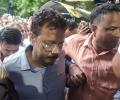
The Supreme Court has granted bail to Sandip Ghosh, former principal of RG Kar Medical College Hospital, who was accused of financial irregularities and manipulating merit scores. The decision was based on his two-year incarceration and the slow progress of the trial, with only 7 out of 147 witnesses examined so far.

The Supreme Court has issued notice to the Election Commission and its chief regarding a plea by Sanjay Raut and 12 others, including Rahul Gandhi, concerning alleged irregularities in electoral roll revisions. The court provisionally entertained Raut's petition but stated he would need to explain his conduct, while also addressing allegations of attempts to 'browbeat' the judiciary.
The Supreme Court has dismissed a plea challenging the resignations of six AIADMK MLAs who subsequently joined the ruling Tamilaga Vettri Kazhagam (TVK). The court affirmed that resignation and disqualification are distinct constitutional processes, upholding the Speaker's acceptance of the resignations and stating that the Speaker was not required to inquire into motives.

Chief Justice of India Surya Kant declined a meeting request from opposition leaders Rahul Gandhi and Mallikarjun Kharge, stating that discussing sub judice matters would violate judicial ethics and the principle of Separation of Powers. He advised them to file a formal petition with the Supreme Court instead of seeking an administrative meeting. The opposition had sought to discuss issues including the Chief Election Commissioner, arrests, and public transport disruptions.

'It is unfortunate that the Chairman of Tata Sons, a Company renowned for setting high standards of corporate governance, is contending reappointment on such an untenable interpretation of the Articles'.

The Supreme Court on Sunday issued a notice to the Centre and passed several directions regarding metro and train services, internet access, and peaceful assembly in Delhi, following a plea for contempt proceedings over alleged violations during the CJP protest. The court emphasised the protection of fundamental rights and the need for lawful conduct during protests.

The Supreme Court has permitted Ashish Mishra, an accused in the 2021 Lakhimpur Kheri violence case and son of former Union minister Ajay Mishra, to travel to his hometown for Diwali celebrations. The court also emphasised the need for a timely conclusion of the trial, noting that 90 out of 131 witnesses have been examined and a new judge and prosecutor have been appointed.

The Meerut district court has convicted Muskan Rastogi and Sahil Shukla for the murder of merchant navy officer Saurabh Rajput in the high-profile 'Blue Drum' case. The court, after a 13-month trial, found them guilty, emphasizing the need for strict punishment in heinous crimes. Sentencing will be announced after 15 days, with the prosecution seeking maximum punishment.

The Supreme Court registry has identified over 10 defects in the petition filed by Congress leader Rahul Gandhi and other opposition leaders concerning alleged large-scale voter deletions and irregularities in electoral rolls. Issues include missing ID cards, illegible pages, and a court fee shortfall. The petition seeks an independent audit of the Special Intensive Revision process.

The Supreme Court on Thursday sought responses from the Centre and Delhi Police regarding an October 11 order that de-notified Jantar Mantar as a protest site and designated three alternative venues. The court will examine the rationale behind the relocation, especially concerning the efficacy of Jantar Mantar and the impact on the fundamental right to protest.

The Delhi Police informed the High Court that Jantar Mantar was denotified as a protest site based on Supreme Court directions, a revelation made during a hearing on a plea by the Indian Youth Congress seeking protest permission. The court issued notice on the IYC's request for reconsideration and broader issues concerning protest regulation, while new sites have been designated.

The Supreme Court of India has sought proposals for establishing a permanent financial corpus to support patients suffering from Spinal Muscular Atrophy (SMA), a rare genetic disorder requiring expensive treatment. This initiative follows an earlier case involving comedian Samay Raina, which led the court to examine broader systemic concerns for SMA patients.

The Delhi High Court has ruled that criminal cases involving sexual offences against children, particularly under the POCSO Act, cannot be settled by the survivor or their family. Justice Sachin Datta emphasised that such heinous offences have a serious societal impact and quashing proceedings based on a compromise would undermine the statute's objectives and justice.
A Meerut court sentenced a woman and her lover to death on Friday for murdering her husband and staging it as a snakebite. The court cited the Manusmriti and the mythological figure Savitri, calling it a "rarest of rare" case.

Former Supreme Court judge Sanjay Kishan Kaul has criticised former Chief Justice of India D Y Chandrachud's approach to judicial appointments, alleging that he was "too deferential to the government". Kaul, in his forthcoming memoir, details instances where Chandrachud sought government "pre-approval" for appointments, raising concerns about judicial independence and executive pressure.
The Supreme Court has made permanent its order protecting a journalist from coercive action in a road rage case and quashed a police notice to 'X' seeking his digital details. The court noted the police sought data from before the alleged crime and granted the journalist liberty to challenge the FIR and seek guidelines for data collection.
The Supreme Court has directed the Centre, states, and Union Territories to swiftly establish dedicated courts to handle the "alarming rise" in cases under the Narcotic Drugs and Psychotropic Substances (NDPS) Act. The directive aims to set up all 449 required NDPS courts within six weeks. Additionally, the court noted progress in establishing special courts for cases probed by the National Investigation Agency (NIA), with several states committing to expedite their operationalisation.
The Supreme Court has ordered the reinstatement of R Saravanan, a deputy registrar of Periyar University, who was dismissed for alleged disproportionate assets. The court observed that dismissal is akin to a "death penalty" for a government servant and criticised the university's inquiry for lacking evidence, upholding the single-judge bench's decision.

The move follows an online meeting held earlier this week, where captains discussed the growing uncertainty surrounding the paused ISL season.

Shiv Sena corporator Ramesh Mhatre and three others have surrendered to a Thane trial court after the Supreme Court cancelled their bail in a doctor assault case. The Supreme Court overturned a Bombay High Court order, emphasizing the importance of doctor safety and noting Mhatre's extensive criminal history.

The Supreme Court has appointed former Delhi High Court judge Justice Najmi Waziri as a mediator to resolve the cheque-dishonour dispute involving actor Rajpal Yadav. The legal battle originated from a 2010 financial agreement for his directorial debut, 'Ata Pata Laapata', where Yadav allegedly issued dishonoured cheques. The actor has deposited Rs 2 crore with the SC registry, and the court has allowed his passport release for professional commitments.

The Supreme Court has sought responses from the Election Commission and Chief Election Commissioner Gyanesh Kumar regarding a plea filed by Congress leader Rahul Gandhi and 12 other opposition leaders concerning alleged large-scale voter deletions and Special Intensive Revision (SIR) irregularities.

The father of a doctor who was raped and murdered has questioned the CBI after former RG Kar Medical College and Hospital principal Sandip Ghosh received bail from the Supreme Court in a financial irregularities case. Ghosh was previously granted bail in the rape-murder case in December 2024 due to the CBI's failure to file a chargesheet. Doctors and the victim's family are criticising the CBI's handling of the investigations, alleging incompetence and delays.

The Supreme Court has granted the Centre an extension until October 15 to file its response on petitions concerning the closure of metro stations and disruption of train services in Delhi during protests against Chief Election Commissioner Gyanesh Kumar and the Special Intensive Revision of electoral rolls. The court also deferred a crucial hearing, issued notice on a petition challenging the immunity of election commissioners, and sought a Delhi Police officer's presence regarding alleged assaults on women journalists. Earlier, the court had directed authorities to ensure normal public transport and prevent unlawful detentions.
Muskan Rastogi and Sahil Shukla have been found guilty by a Meerut district court in the sensational "Blue Drum" murder case, involving the killing of merchant navy officer Saurabh Rajput. The court, citing a Supreme Court order on strict punishment for serious crimes, will announce the sentence after 15 days. The prosecution presented 22 witnesses and sought maximum punishment for the accused.
Muskan Rastogi and Sahil Shukla have been found guilty by a Meerut district court in the sensational "Blue Drum" murder case, involving the killing of merchant navy officer Saurabh Rajput. The court, citing a Supreme Court order on strict punishment for serious crimes, will announce the sentence after 15 days. The prosecution presented 22 witnesses and sought maximum punishment for the accused.

Chief Justice of India Surya Kant has stated that the ongoing protests against Chief Election Commissioner Gyanesh Kumar and the associated restrictions in Delhi fall under law and order, not his judicial purview, and declined to meet opposition leaders regarding the issue.

The Delhi High Court is set to hear petitions concerning the alleged closure of Jantar Mantar as a protest site and reported assaults on protesters. Lawyers argue that the closure infringes on the right to free speech, especially as no alternative sites were designated. Separately, Delhi Police have denotified Jantar Mantar and named three new protest locations.
